 260287b3a1
While all the previous fixes to optimizeVertexCache invocation fixed the
vertex transform efficiency, the import code still was missing two
crucial recommendations from meshoptimizer documentation:

- All meshes should be optimized for vertex cache (this reorders
  vertices for maximum fetch efficiency)
- When LODs are used with a shared vertex buffer, the vertex order
  should be generated by doing a vertex fetch optimization on the
  concatenated index buffer from coarse to fine LODs; this maximizes
  fetch efficiency for coarse LODs

The last point is especially crucial for Mali GPUs; unlike other GPUs
where vertex order affects fetch efficiency but not shading, these GPUs
have various shading quirks (depending on the GPU generation) that
really require consecutive index ranges for each LOD, which requires the
second optimization mentioned above. However all of these also help
desktop GPUs and other mobile GPUs as well.

Because this optimization is "global" in the sense that it affects all
LODs and all vertex arrays in concert, I've taken this opportunity to
isolate all optimization code in this function and pull it out of
generate_lods and create_shadow_mesh; this doesn't change the vertex
cache efficiency, but makes the code cleaner. Consequently,
optimize_indices should be called after other functions like
create_shadow_mesh / generate_lods.

This required exposing meshopt_optimizeVertexFetchRemap; as a drive-by,
meshopt_simplifySloppy was never used so it's not exposed anymore - this
will simplify future meshopt upgrades if they end up changing the
function's interface.


Godot Engine

2D and 3D cross-platform game engine
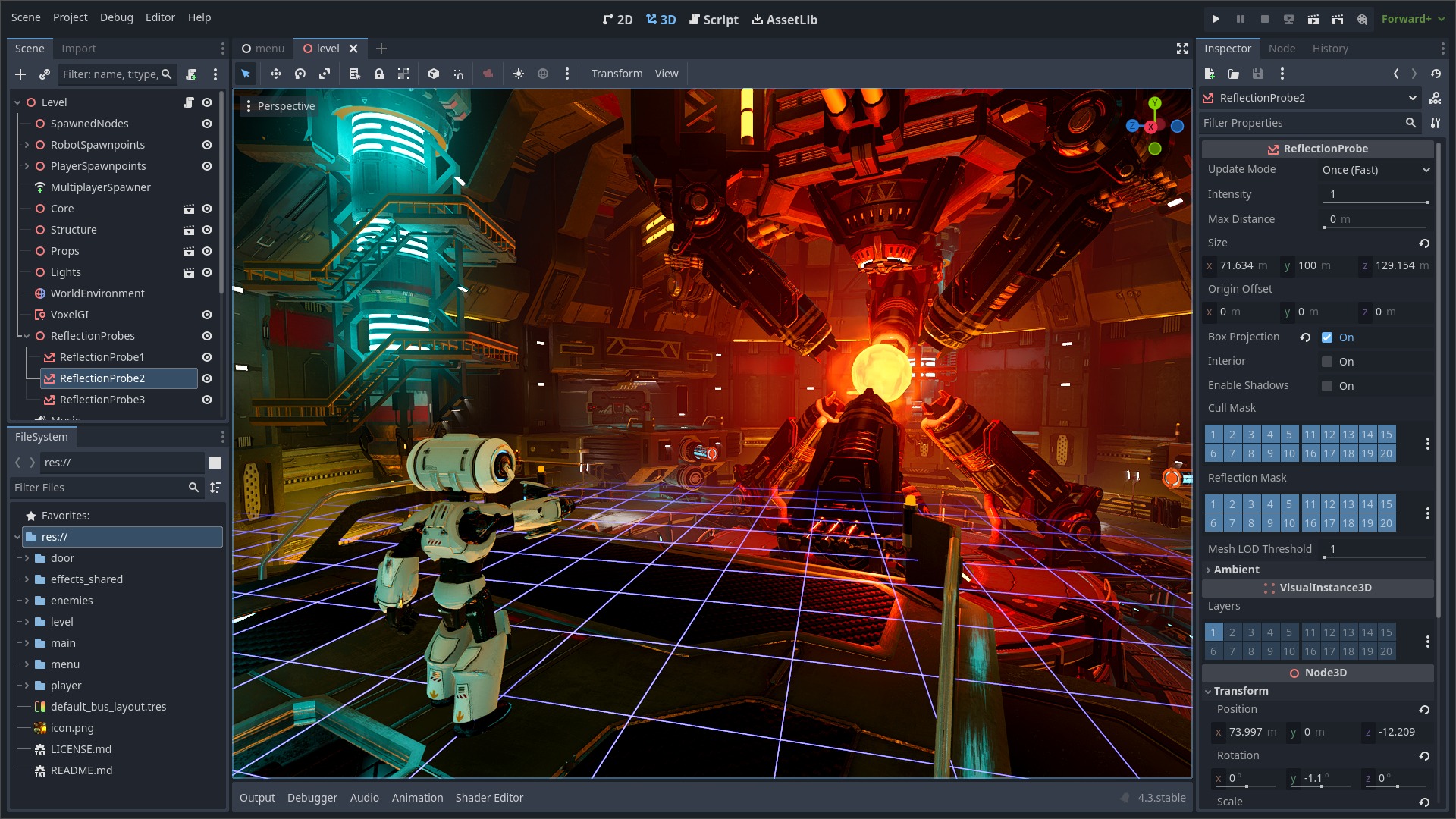
Godot Engine is a feature-packed, cross-platform game engine to create 2D and 3D games from a unified interface. It provides a comprehensive set of common tools, so that users can focus on making games without having to reinvent the wheel. Games can be exported with one click to a number of platforms, including the major desktop platforms (Linux, macOS, Windows), mobile platforms (Android, iOS), as well as Web-based platforms and consoles.
Free, open source and community-driven
Godot is completely free and open source under the very permissive MIT license. No strings attached, no royalties, nothing. The users' games are theirs, down to the last line of engine code. Godot's development is fully independent and community-driven, empowering users to help shape their engine to match their expectations. It is supported by the Godot Foundation not-for-profit.
Before being open sourced in February 2014, Godot had been developed by Juan Linietsky and Ariel Manzur (both still maintaining the project) for several years as an in-house engine, used to publish several work-for-hire titles.
Getting the engine
Binary downloads
Official binaries for the Godot editor and the export templates can be found on the Godot website.
Compiling from source
See the official docs for compilation instructions for every supported platform.
Community and contributing
Godot is not only an engine but an ever-growing community of users and engine developers. The main community channels are listed on the homepage.
The best way to get in touch with the core engine developers is to join the Godot Contributors Chat.
To get started contributing to the project, see the contributing guide. This document also includes guidelines for reporting bugs.
Documentation and demos
The official documentation is hosted on Read the Docs. It is maintained by the Godot community in its own GitHub repository.
The class reference is also accessible from the Godot editor.
We also maintain official demos in their own GitHub repository as well as a list of awesome Godot community resources.
There are also a number of other learning resources provided by the community, such as text and video tutorials, demos, etc. Consult the community channels for more information.

